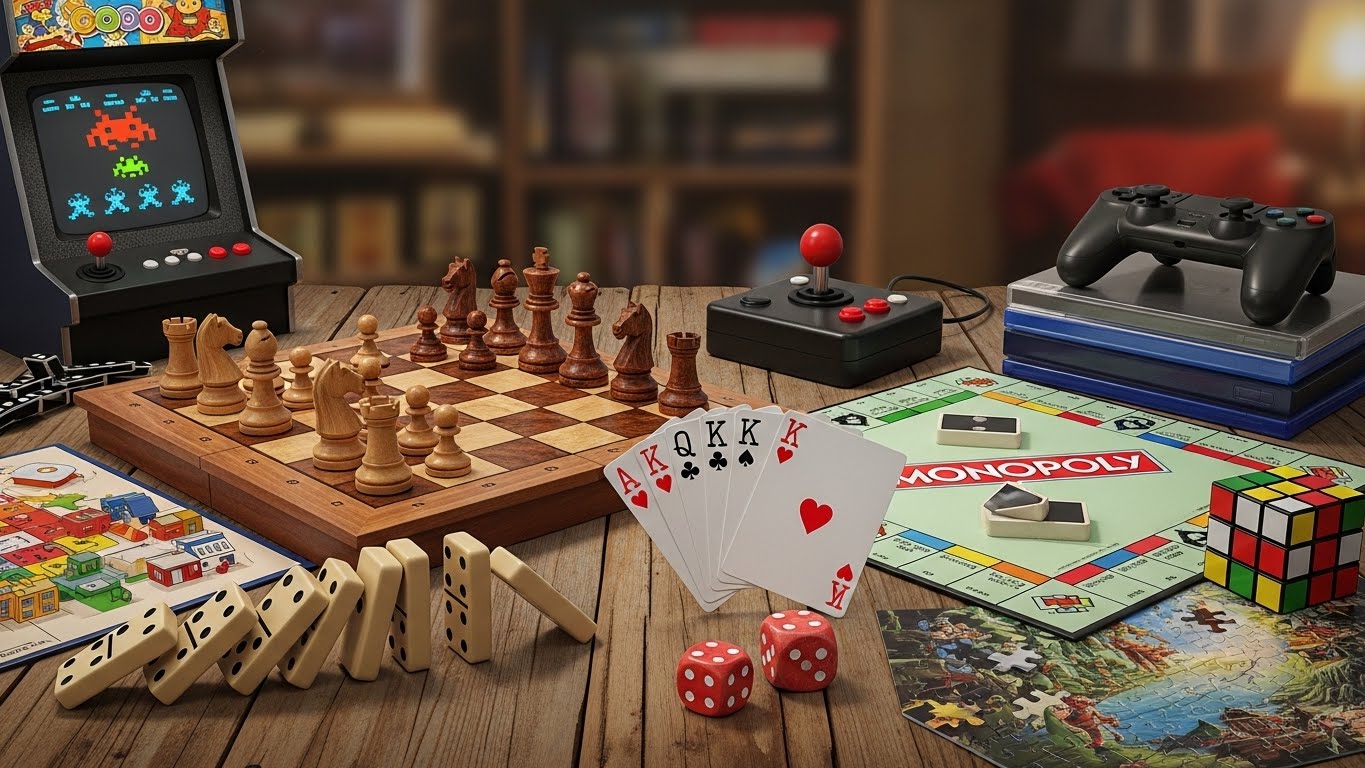

Gaming has come a long way since the days of pixelated characters and simple joystick controls. What once began as a niche hobby has blossomed into a global industry worth billions of dollars, captivating millions of players across the world. The gaming experience has evolved from arcade machines to consoles, and now to sprawling virtual worlds that immerse players in a variety of interactive, complex narratives. In this blog post, we will explore how gaming has transformed over the years and how its cultural significance continues to grow in the digital age.
The Early Days of Gaming: A Humble Beginning
The origins of modern video gaming can be traced back to the 1950s and 1960s, with rudimentary games like Tennis for Two and Spacewar! being some of the first interactive experiences. However, it wasn’t until the early 1970s that gaming truly began to take off. The advent of arcade games like Pong in 1972 marked a pivotal moment in the gaming world. Simple yet addictive, Pong was a two-player game that simulated table tennis, and it became a massive hit. This laid the groundwork for the arcade gaming culture, where people flocked to arcades to compete for high scores and engage in friendly rivalries.
The late 1970s and early 1980s saw the rise of other iconic arcade games such as Pac-Man, Donkey Kong, and Asteroids. These games were simple by today’s standards but were revolutionary at the time, offering engaging gameplay and introducing memorable characters. The iconic yellow, chomping circle from Pac-Man or the barrel-rolling Donkey Kong became symbols of early video gaming and remain iconic figures in the gaming world.
At the same time, home consoles began to emerge, with the Atari 2600 released in 1977 being one of the first to bring gaming into the living room. These consoles gave players the ability to play games at home, making gaming more accessible and convenient than ever before. As technology progressed, the early games evolved into more sophisticated experiences, though they remained largely 2D, with simple mechanics.
The 16-Bit Era: The Rise of Console Wars
The 1990s marked a significant turning point in the evolution of gaming, with the arrival of 16-bit consoles like the Super Nintendo Entertainment System (SNES) and the Sega Genesis. These systems delivered enhanced graphics, faster processing power, and a wider variety of games, pushing the boundaries of what was possible in the gaming world. The leap from 8-bit to 16-bit allowed for more intricate gameplay and detailed visuals, which helped solidify video games as a legitimate form of entertainment.
This era also introduced some of the most iconic franchises in gaming history, including Super Mario World, Sonic the Hedgehog, and The Legend of Zelda: A Link to the Past. These games weren’t just fun—they were well-crafted experiences that allowed players to immerse themselves in fantastical worlds. Super Mario World, with its vibrant levels and fluid controls, showcased the possibilities of platforming games, while The Legend of Zelda elevated the action-adventure genre to new heights, offering an expansive world to explore and puzzles to solve.
At the same time, the competition between Sega and Nintendo ignited what is often referred to as the “console wars.” Both companies released their flagship systems, sparking intense rivalries among fans. The Genesis offered games like Streets of Rage and Mortal Kombat, which appealed to a more mature audience, while the SNES focused on family-friendly titles like Super Mario and Kirby. This rivalry fueled innovation, as both companies tried to outdo each other in terms of hardware and game design.
The 3D Revolution: A New Dimension of Gameplay
By the mid-1990s, the gaming landscape underwent another major transformation with the advent of 3D graphics. Sony’s PlayStation, released in 1994, was a game-changer, introducing fully three-dimensional gaming worlds to players. With titles like Gran Turismo, Final Fantasy VII, and Crash Bandicoot, the PlayStation showed the power of 3D rendering and set a new standard for how games would look and feel. The introduction of 3D environments allowed for a deeper sense of immersion, making players feel as though they were stepping inside the games themselves.
The Nintendo 64, released in 1996, was another milestone in this 3D revolution. Games like Super Mario 64 and The Legend of Zelda: Ocarina of Time were groundbreaking in their use of 3D space. Super Mario 64 changed the platforming genre forever by introducing an open-world design that allowed players to explore a vast environment with freedom and creativity. Similarly, Ocarina of Time elevated the action-adventure genre by blending puzzle-solving, combat, and exploration in a 3D world.
The shift from 2D to 3D brought a new level of complexity to game design, and developers began to experiment with more sophisticated narratives and gameplay mechanics. This period saw the rise of open-world games, which allowed players to roam vast, interconnected environments, and role-playing games (RPGs), which told deeper and more emotionally engaging stories.
Online Gaming: The Emergence of Multiplayer Worlds
The late 1990s and early 2000s ushered in a new era for gaming—one that was driven by online multiplayer experiences. The ability to connect to the internet and play with people from around the world marked a shift in how games were designed and played. Multiplayer online games such as Warcraft II and StarCraft introduced competitive gaming on a global scale, paving the way for the Massively Multiplayer Online Role-Playing Game (MMORPG) genre.
The release of World of Warcraft in 2004 was a key moment in this online revolution. As one of the most successful MMORPGs of all time, World of Warcraft allowed players to explore a massive online world filled with quests, dungeons, and raids, all while interacting with thousands of other players in real time. This created a sense of community and collaboration that was previously unseen in gaming, and its influence can still be seen in modern online games.
At the same time, consoles began to integrate online multiplayer features. Xbox Live, introduced by Microsoft in 2002, allowed Xbox owners to connect with other players and participate in online games like Halo 2 and Gears of War. The introduction of online gaming into the console space further cemented gaming’s place as a social activity that transcended geographic boundaries.
The Mobile Revolution: Gaming on the Go
By the 2010s, smartphones and tablets became ubiquitous, and with them came the mobile gaming revolution. Mobile games like Angry Birds, Candy Crush Saga, and Pokémon GO brought gaming to a broader audience than ever before. Mobile gaming allowed people to play whenever and wherever they wanted, and the accessibility of these games made them an ideal choice for casual gamers.
Mobile gaming has become a major force in the industry, with some games generating billions of dollars in revenue through in-app purchases and microtransactions. While mobile games are often simpler than console or PC games, they are no less engaging. Games like Clash of Clans, Fortnite, and PUBG Mobile have introduced new ways for players to compete and cooperate in mobile formats, further blurring the lines between casual and hardcore gaming.
The shift to mobile gaming has also changed how developers approach game design. While console and PC games are often long and intricate experiences, mobile games are designed for shorter, more bite-sized sessions. However, the constant access to a gaming platform has led to new innovations in terms of in-game events, social features, and constant updates.
Virtual Reality and Augmented Reality: The Next Frontier
As technology continues to advance, new forms of gaming are emerging. Virtual reality (VR) and augmented reality (AR) are two technologies that are pushing the boundaries of what gaming can be. VR, which immerses players in fully digital environments using headsets like the Oculus Rift and PlayStation VR, offers a level of immersion previously unavailable in gaming. Games like Beat Saber, Half-Life: Alyx, and VRChat have shown the potential of VR as a platform for gaming, creating experiences where players feel as though they are truly “inside” the game world.
Augmented reality, on the other hand, overlays digital elements onto the real world through smartphones or AR glasses. Pokémon GO, which launched in 2016, was one of the first major successes of AR gaming, encouraging players to explore their neighborhoods in search of virtual creatures. AR has the potential to revolutionize mobile gaming by blending the physical world with digital elements, creating new forms of interaction.
The Future of Gaming: Streaming, AI, and Beyond
As we look to the future of gaming, it’s clear that new technologies will continue to shape the way we play. Cloud gaming, for example, allows players to stream games directly from the internet without the need for powerful hardware. Services like Google Stadia and Xbox Cloud Gaming are paving the way for gaming on any device with an internet connection, further breaking down the barriers between consoles, PCs, and mobile devices.
Artificial intelligence is also expected to play a larger role in game design, from creating more responsive non-playable characters (NPCs) to generating dynamic and evolving game worlds. AI could allow for more personalized gaming experiences, where the game world adapts to each player’s behavior and decisions.