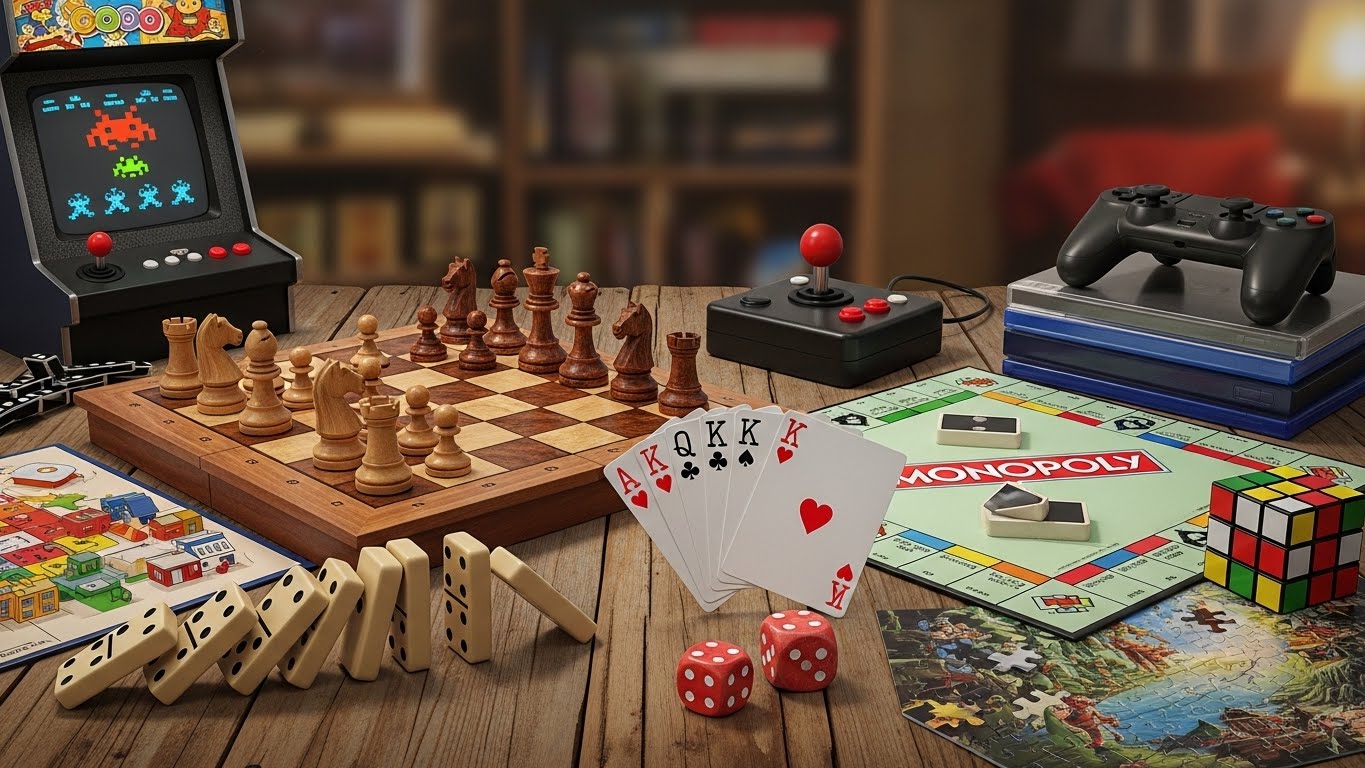

Games have always been an inseparable part of human civilization. From the earliest board games played thousands of years ago to the cutting-edge virtual experiences of today, games have evolved into a vast and diverse cultural phenomenon. They entertain us, challenge our minds, and bring people together across generations, languages, and borders. The story of games is not just a story of play; it is a reflection of human creativity, intelligence, and the desire for connection.
The Origins of Games
The history of games can be traced back to ancient civilizations. Archaeologists have discovered evidence of board games in Mesopotamia, Egypt, China, and the Indus Valley. One of the oldest known games, Senet, was played in ancient Egypt around 3100 BCE. It was more than just entertainment; it carried spiritual significance and was believed to represent the journey of the soul through the afterlife. Similarly, the Royal Game of Ur from Mesopotamia is considered one of the earliest examples of strategic play, using dice and carved pieces.
In ancient China, games such as Go and Liubo were played by scholars and nobles. Go, in particular, stands as a timeless example of intellectual depth. Despite its simple rules, it requires immense strategic thinking and foresight. In India, games like Pachisi and Chaturanga emerged. Chaturanga eventually evolved into the game of chess, which became one of the world’s most enduring and intellectually respected games.
These early games were more than idle amusement. They taught strategy, patience, and decision-making, often mirroring the complexities of life and war. They also provided a sense of community, where people gathered to test their wits and share laughter.
The Evolution of Physical Games
As societies developed, so did the forms of games. In ancient Greece, games took on a physical dimension with the introduction of athletic competitions. The Olympic Games, established in 776 BCE, celebrated human strength, agility, and endurance. These contests became symbolic of honor and excellence, setting a foundation for modern sportsmanship.
In medieval Europe, games like jousting, archery, and fencing were popular among knights and nobles. Meanwhile, the common people enjoyed games such as dice, cards, and simple ball games. As the printing press spread through Europe, card games flourished, evolving into diverse forms such as Poker, Bridge, and Solitaire.
The Industrial Revolution brought significant changes to the world of games. With more leisure time and mass production, board games became widely accessible. Classics like Monopoly, Scrabble, and Clue emerged, turning homes into miniature playgrounds of strategy and imagination. These games encouraged creativity, vocabulary skills, and social interaction, paving the way for the modern gaming industry.
The Birth of Digital Games
The 20th century marked a technological revolution that forever changed the way we play. The invention of computers and electronic devices gave rise to a new form of entertainment — video games. The first recognizable video game, Pong, was released in 1972. It was a simple digital version of table tennis, but it sparked a cultural movement. People were fascinated by the idea of playing games on a screen rather than a physical board.
Following Pong’s success, the arcade era began. Games like Space Invaders, Pac-Man, and Donkey Kong turned video gaming into a social activity where players gathered in arcades to chase high scores. Each game brought unique mechanics and iconic characters, establishing the foundation of digital entertainment.
As technology advanced, home consoles entered the market. The Atari 2600, Nintendo Entertainment System (NES), and Sega Genesis brought gaming into living rooms worldwide. Characters like Mario, Sonic, and Link became cultural icons, symbolizing the creativity and storytelling potential of interactive entertainment.
The Rise of Modern Gaming Platforms
By the 1990s, gaming had transformed from a niche hobby into a mainstream industry. The arrival of powerful consoles such as the PlayStation and Nintendo 64 introduced 3D graphics and immersive worlds. Games like Final Fantasy VII, The Legend of Zelda: Ocarina of Time, and Metal Gear Solid demonstrated that video games could be as emotionally deep and narratively complex as films or novels.
At the same time, computer gaming grew rapidly. The rise of personal computers allowed developers to experiment with strategy games, simulations, and online multiplayer experiences. Titles like StarCraft, The Sims, and Half-Life pushed the boundaries of creativity and gameplay mechanics.
With the turn of the millennium, the internet changed everything once again. Online gaming became a cultural force, connecting players from all corners of the globe. Massive Multiplayer Online Role-Playing Games (MMORPGs) such as World of Warcraft created virtual worlds where millions of people could interact, collaborate, and compete in real time.
The Role of Storytelling in Games
Games have evolved far beyond simple mechanics or competition. Today, they serve as powerful storytelling mediums. Titles like The Last of Us, Red Dead Redemption 2, and Journey have proven that games can evoke deep emotions and deliver cinematic experiences. These stories blend narrative, music, art, and interactivity to create something unique — a form of storytelling where the player becomes part of the narrative.
Unlike films or books, video games give players agency. The choices made by the player can influence outcomes, creating a personal connection to the story. This interactivity makes storytelling in games deeply immersive and emotionally resonant. Players do not simply watch events unfold; they live them.
The Cultural Impact of Games
The influence of games extends far beyond entertainment. They have become an integral part of global culture, shaping how people think, communicate, and collaborate. Esports, for instance, has turned competitive gaming into a global phenomenon, with professional players, massive tournaments, and millions of spectators. Games like League of Legends, Dota 2, and Counter-Strike have elevated gaming to a professional sport level, complete with coaches, sponsors, and prize pools worth millions.
Moreover, games have fostered creativity in other industries. Many films, books, and music albums draw inspiration from video game aesthetics and narratives. Game design principles are now being applied in education, healthcare, and corporate training. The concept of “gamification” — applying game mechanics to non-gaming activities — is used to make learning and productivity more engaging.
The Psychology of Gaming
One of the most fascinating aspects of gaming is its psychological impact. Games appeal to our intrinsic motivations: the desire for achievement, mastery, and exploration. They provide a safe environment where failure is not final but a step toward improvement. This structure encourages persistence and problem-solving, skills valuable in real life.
Additionally, games offer a sense of escape and relaxation. In an increasingly stressful world, gaming provides an outlet for creativity and stress relief. Multiplayer games also serve as social spaces where friendships are formed and communities thrive. Players from different countries, backgrounds, and cultures can come together, breaking barriers through shared experiences.
However, like any powerful medium, games also have challenges. Concerns about addiction, violence, and excessive screen time have sparked debates among parents, educators, and psychologists. The key lies in balance and understanding — recognizing that while games can be deeply engaging, they must be enjoyed responsibly.
The Role of Technology in Game Development
Technology has always been the driving force behind gaming innovation. The leap from 8-bit graphics to lifelike 3D worlds is nothing short of extraordinary. Modern games use advanced physics engines, motion capture, and artificial intelligence to create realistic and dynamic environments.
Virtual reality (VR) and augmented reality (AR) have opened entirely new dimensions of play. VR immerses players in fully digital worlds, while AR blends the real and virtual. Games like Beat Saber and Pokémon Go have shown how these technologies can redefine what gaming means, turning movement and physical interaction into integral parts of the experience.
Artificial intelligence is also transforming the gaming landscape. Non-player characters (NPCs) are becoming more lifelike, capable of adapting to player behavior. Procedural generation — the use of algorithms to create vast and varied environments — allows for limitless possibilities.
Indie Games and the Spirit of Creativity
While big-budget studios dominate the industry, the rise of indie games has proven that innovation thrives in creativity, not just scale. Independent developers often bring fresh ideas and emotional depth to gaming. Titles like Undertale, Celeste, and Hollow Knight have captivated audiences with their artistry, storytelling, and originality.
Indie developers take risks that large studios might avoid. They experiment with new mechanics, unique art styles, and unconventional narratives. This diversity enriches the gaming world, ensuring that it remains vibrant and ever-evolving.
Gaming Communities and Social Connection
One of the most powerful aspects of gaming today is the community. Online platforms, live streaming, and social media have transformed gaming into a shared experience. Players no longer just play — they watch, comment, create, and connect. Platforms that allow streaming and community engagement have made gaming a spectator sport and a cultural conversation.
These communities often go beyond entertainment. Players collaborate for charity, share creative projects, and even form lifelong friendships. Gaming has become a digital meeting ground where art, competition, and companionship converge.
The Educational and Therapeutic Power of Games
In recent years, educators and scientists have recognized the potential of games in learning and therapy. Educational games make subjects like mathematics, history, and science interactive and enjoyable. They encourage critical thinking, experimentation, and curiosity.
Therapeutic games, on the other hand, assist in mental health treatment, physical rehabilitation, and cognitive training. Games designed for therapy can help patients improve memory, coordination, and emotional well-being. They provide motivation and structure in ways that traditional methods sometimes cannot.
The Future of Gaming
The future of gaming holds limitless potential. Advances in artificial intelligence, cloud computing, and neural interfaces are set to revolutionize the experience further. Cloud gaming allows players to stream high-quality games without powerful hardware, making gaming more accessible than ever.
AI-driven storytelling may soon enable dynamic narratives that change with every playthrough, adapting to each player’s emotions and decisions. Haptic feedback, brain-computer interfaces, and photorealistic graphics will blur the line between the real and virtual worlds.
Moreover, as society embraces sustainability and inclusivity, the gaming industry is evolving too. Developers are focusing on creating diverse characters, ethical storytelling, and environmentally conscious production methods. The games of the future will not only entertain but also educate, inspire, and connect humanity in deeper ways.
Conclusion
Games have journeyed from simple carvings on stone boards to complex digital universes powered by artificial intelligence. They mirror human evolution — our creativity, our need for challenge, and our desire for connection. Whether played with dice on a wooden board or in a fully immersive virtual world, games continue to remind us of the joy of play.
At their core, games represent the human spirit’s endless curiosity and imagination. They teach us to compete, to collaborate, to persevere, and to dream. The world of games is not just about winning or losing; it is about exploration, growth, and shared experience. As technology continues to advance, one truth remains timeless — as long as there are humans, there will be games.